Department of Geography, Sociology, History, Africana Studies & Anthropology (GSHAA)
Navigating the intersection of environment, economy, and community
CSU’s Department of Geography, Sociology, History, Africana Studies and Anthropology
(GSHAA) is a dynamic, multi/interdisciplinary, community-focused department dedicated
to the promotion of social and environmental justice and equity in a rapidly changing
and challenging world.
Each of our programs serves the State of Illinois, Chicago’s South Side and southern
suburbs, and students from all over the world. We provide quality instruction through
pertinent scholarly and technological methods while our scholarship and practice focus
on the intersection of environment, culture, and society.
Explore our programs
Explore each of the undergraduate and graduate programs in GSHAA to learn about courses,
academic requirements, and paths to your degree.
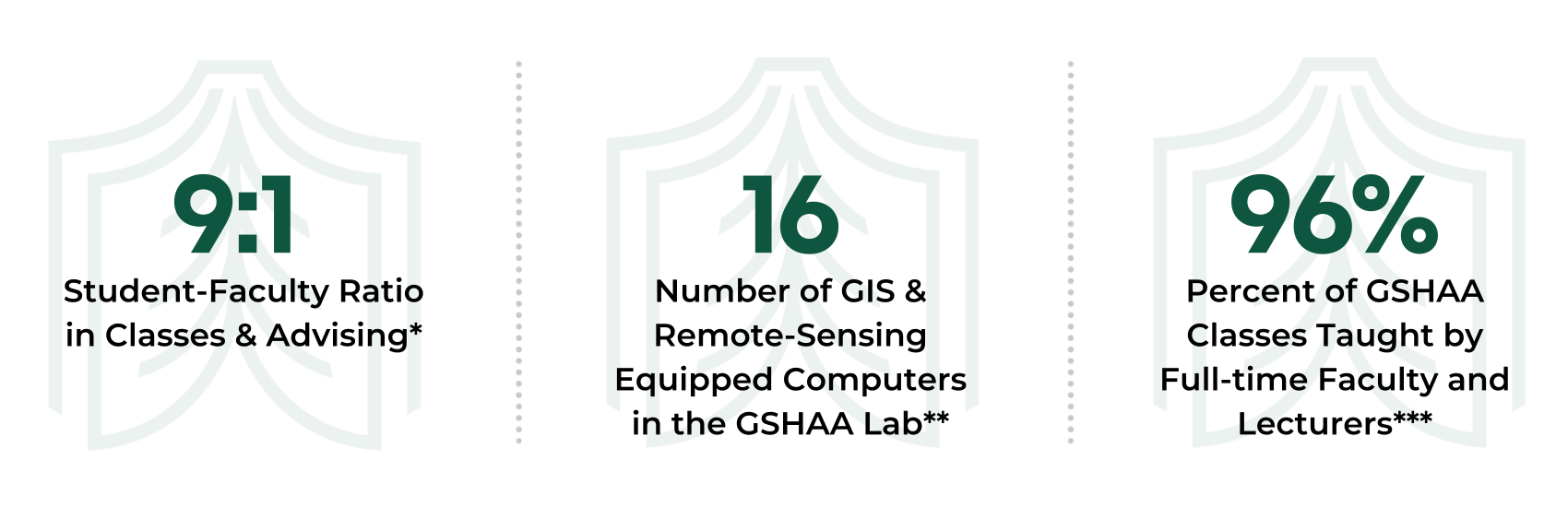
Small class sizes and individualized attention: 5:1 student-faculty ratio in classes and advising.
Hands-on access to specialized technology: 16 GIS and remote-sensing-technology-equipped computers in the GSHAA Lab.
Internship Opportunities: the Fred Blum Neighborhood Assistance Centre (NAC), and the Calumet Environmental
Resource Centre (CERC).
Instruction led by experts: 75% of classes are taught by full-time faculty and lecturers.
Active professional development and networking: Students have opportunities to present their work at regional and national conferences.
*IPEDS 21-22 Data Collection: Fall 2021 Enrollment, Student-to-Faculty Ratio
**GSHAA Department Resources
***CSU Course Schedules, Fall 2021-Summer 2022 (includes 75 or 78 total classes)
Examine global issues in a dynamic local context
The Department of Geography, Sociology, History, Africana Studies and Anthropology
occupies a unique space within the university, the Chicago region and the higher education
landscape. As a federally recognized Predominately Black Institution (PBI), we explore
the connection of Africans and African diaspora experiences in our community to global,
environmental, cultural and socioeconomical dynamics.
Our faculty and students work directly with our local community to address critical
issues including:
Food Anatomy, security and urban agriculture: Building sustainable food systems.
Environmental and climate justice: Examining the impacts of climate change on Chicago and the surrounding regions.
Digital equity and access: Expanding technology access across urban communities.
Development and planning: Analyzing community growth and policy through geographic and historical lens.
Social Inequality: Analyzing the intersection of Race, Class, Gender, Sexuality, Residential Segregation
and Serial Murder.
Production of History: Oral Traditions, Memories, Dress, Social Change & Differentiation, and the (Re) Construction
of Identity
Neighborhood Assistance Center
A major focus of CSU's contribution to the economic development and social welfare
of the Chicago area is through the Department's Fredrick Blum Neighborhood Assistance
Center (NAC). Working with faculty and staff, the NAC provides students many opportunities
to analyze, develop solutions for, and reflect upon a variety of urban problems.
Another CSU's contribution to social and environmental justice in Chicago area is
through the Department's Calumet Environmental Resource Centre (CERC). Leveraging
over dozens of climates and environmental sensors and working with faculty and staff,
the CERC provides students with valuable opportunities of experiential learning, internship-related
activities, skills in environmental data analysis and community-based research.
Forest Park and Natural Resources management and conservation
Geographic Information Systems (GIS)
Law and international affairs
Teaching (High School or College)
Advances to Graduate Studies
Additional career paths include cartographer, GIS specialist, Photogrammetry, urban
and regional planner, public policy analyst, environmental consultants, social and
human services, teaching, community leadership, and marketing communications.
Compare career outcomes by occupation
Explore where a Chicago State University education can take you. Whether you’re choosing
a major or planning your career, these resources can help you explore your options
and make informed decisions about your future.
Master of Arts in Geographic Information Science and Geography Project Manager, Department of Environment, City of Chicago
Sophia is the Strategic Partnerships Project Manager for the City of Chicago Department
of Environment's Bureau of Climate and Environmental Equity. Since joining the department
in October 2024, she has led strategic partnerships that advance climate resilience
through community engagement, cross-sector collaboration, and equitable environmental
policy.
Sophia guides the collaboration and application of the Heat Vulnerability Index (HVI),
a geospatial data tool used to inform city planning, identify communities experiencing
greater heat impacts, and support equitable decision-making. Through partnerships
with organizations such as the Chicago Park District, the HVI has helped inform targeted
cooling investments and strategies to better serve communities most vulnerable to
extreme heat.
Kori Riley, Class of 2024
Master of Arts in Geographic Information Science and Geography Bachelor of Arts in History (Africana Studies concentration)
“Africana Studies at Chicago State University provided me with an exceptional educational
experience. The faculty challenged me to think critically, question assumptions, and
foster my intellectual growth. Their mentorship helped me develop a nuanced understanding
of global issues through a multidisciplinary lens.”
“Beyond the classroom, the Program provided me with opportunities to engage in meaningful
experiential learning. I worked as a student assistant at the Global Engagement Office,
where I shared my firsthand experiences studying abroad in Africa with fellow students.
This experience allowed me to apply the knowledge and perspectives I gained in the
Africana Studies program to foster intercultural exchange.”
Zana Ghareeb, Class of 2022
Master of Arts in Geography, Urban & Environmental Studies, Geographic Information
Systems (GIS) concentration Engineering & Development, Metropolitan Nashville Airport Authority
“The comprehensive curriculum, expert faculty guidance, and hands-on learning opportunities
were instrumental in shaping my expertise. My academic journey not only honed my technical
proficiency with GIS software but also fostered critical thinking and problem-solving
abilities.”
“I came to CSU from Iraq as an international student to pursue my Master's degree
in Geography with a specialization in Geographic Information Systems (GIS). I had
the privilege of gaining invaluable knowledge and skills that have propelled my career
in the GIS domain. The comprehensive curriculum, expert faculty guidance, and hands-on
learning opportunities were instrumental in shaping my expertise. My academic journey
not only honed my technical proficiency with GIS software but also fostered critical
thinking and problem-solving abilities.
“The transition from academia to the professional realm was seamless, thanks to the
practical experience and industry insights gained through internships and projects
facilitated by the GIS program. One of the highlights of my career was my tenure as
a GIS Analyst with VetFedCareNet Healthcare Company, where I played a pivotal role
in leveraging GIS technology to improve healthcare services for veterans along the
West Coast of the United States. The interdisciplinary approach fostered by the Geography
Department at CSU empowered me to apply GIS methodologies across different sectors,
amplifying the impact of spatial analysis in addressing societal needs. “I am immensely grateful for the education and mentorship I received at CSU. The rigorous
academic curriculum, coupled with the supportive learning environment, laid the groundwork
for my professional success.”




 All Rights Reserved